A journey into witchcraft in Emma Quilty’s Witch Power
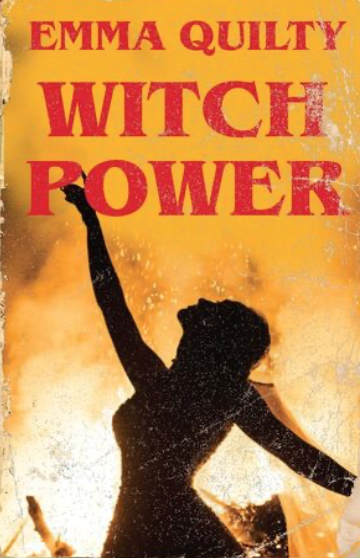
For a work that is a serious piece of scholarship, Emma Quilty's Witch Power is unusually pacy. An anthropologist and self-described “witchy feminist”, Emma's work is a journey into witchcraft in the flesh and online, entwined with deep academic research, political theory, amusing asides and a lot of honesty about her life and the community she is part of.
I came to this book browsing the catalogue of Polity Press, one of my favourite academic publishing houses. I am not a witch but witches have long been a persistent, shape-shifting presence in my life — in pop culture, at stalls at local markets — so I thought I had some sense of the territory. I didn’t! There is so much fresh, fascinating material in this book that I found myself constantly pausing, taking notes, and looking up things online. And while it offers insight into the lives of contemporary witches—Emma goes to a "red tent" period workshop, hexes an ex and hangs out with a voodoo priestess in New Orleans—it is also a history and ethnography of women’s lives.
As Emma writes, before the 15th century, witches were gender neutral; wicca was the masculine and wicce was the feminine. But over time, witches became more associated with women and while there is debate as to why, for Emma, “the short answer is power”. The period of the infamous witch trials between the 15th and 17th centuries was a time of immense social change, when the world was shifting from feudalism to early capitalism in Europe, and there were splits in the Church. One avenue for the Church to maintain power was to expel threats, which meant executing heretics, including witches.
According to the witch-hunter manual Malleus Maleficarium, published in 1486 and known as The Hammer of Witches, “all witchcraft comes from carnal lust which in women is insatiable”. By framing female sexuality as inherently dangerous and something to be controlled, institutions dependent on women's unpaid domestic labour created a brutal system of reward and punishment: conform or burn. Thus, this campaign of burning witches was both a theological and social project.
There are many theories as to why more female witches died than male ones in these horrific hunts. They range from male doctors wanting to take the power women had as healers and midwives to a dreadful example of a moral panic. According to Emma, the dominant theory, which now underpins popular contemporary witchcraft, came from the British archaeologist and folklorist Margaret Murray. In work published in 1921 and 1931, Murray posited that witchcraft was part of an ancient fertility cult dedicated to the Goddess Diana, whose members had been "practising their craft peacefully for the good of the community” for thousands of years before being persecuted in Middle Ages and forming “an underground resistance against the Church and the state”. They later transformed, as Ronald Hutton describes them, into “practitioners of a particular kind of nature-based Pagan religion; or as a symbol of independent female authority and resistance to male domination.” Inspired by this independence and resistance, the witch was picked up and reclaimed by first and second wave feminists.
While an “insider”, Emma doesn’t romanticise witches and with frankness, examines the many debates within the community which range from why witchcraft is so white (her mother is Fijian) to its commercialisation, which has seen white sage smudge sticks, used as part of cleansing rituals, now sold by Etsy and Gwyneth Paltrow’s “Goop” store.
Emma travels to New Orleans and this section of the book, which focuses on her encounters with local witches and on the life of Marie Catherine Laveau, a 19th century voodoo practitioner and activist, is particularly absorbing. The founder of American voodoo, Laveau was a free black woman in a slave society and a Catholic, who ended up working as a hairdresser for the wealthy when her husband died. It was while in these salons that she used the gossip she picked up to gain enormous social power.
This was not unusual: historians have long recognised the significant role the black beauty industry and salons played in providing important opportunities for black women to lead in their communities and in the civil rights movement. As Emma writes: “Gossip, in these settings, has the potential be mobilised in order to actively resist dominant structures of political power and control.”
Emma uses this "gossip as power” notion to explore the incredible history of the word gossip, which dates to the 12th century. What began as a noun to describe women assisting in childbirth became a verb to describe a meeting of female friends. Gossip circles became like salons where women would discuss the personal and the political, and as men were excluded from this form of social capital, "gossip began to develop negative connotations". Plays funded by guilds of merchants and craftsmen in the 15th and 16th centuries often ridiculed gossips as a way to reinforce "their preferred social order and norms, with women confined to private spaces such as the home …"
Aside from portraying women as gossips, the scolds or "witches" bridle also emerged, a form of torture meted out to women seen as troublesome. The bridle was a mask which had a bit which went into the wearers mouth to silence them. "Imagine being a woman during these times and seeing your friends, your neighbours, being forced to wear the scold's bridle in public. The fear of this happening to you should you be accused of being a gossip or quarrelsome with your husband would have been made more real and immediate,” she writes.
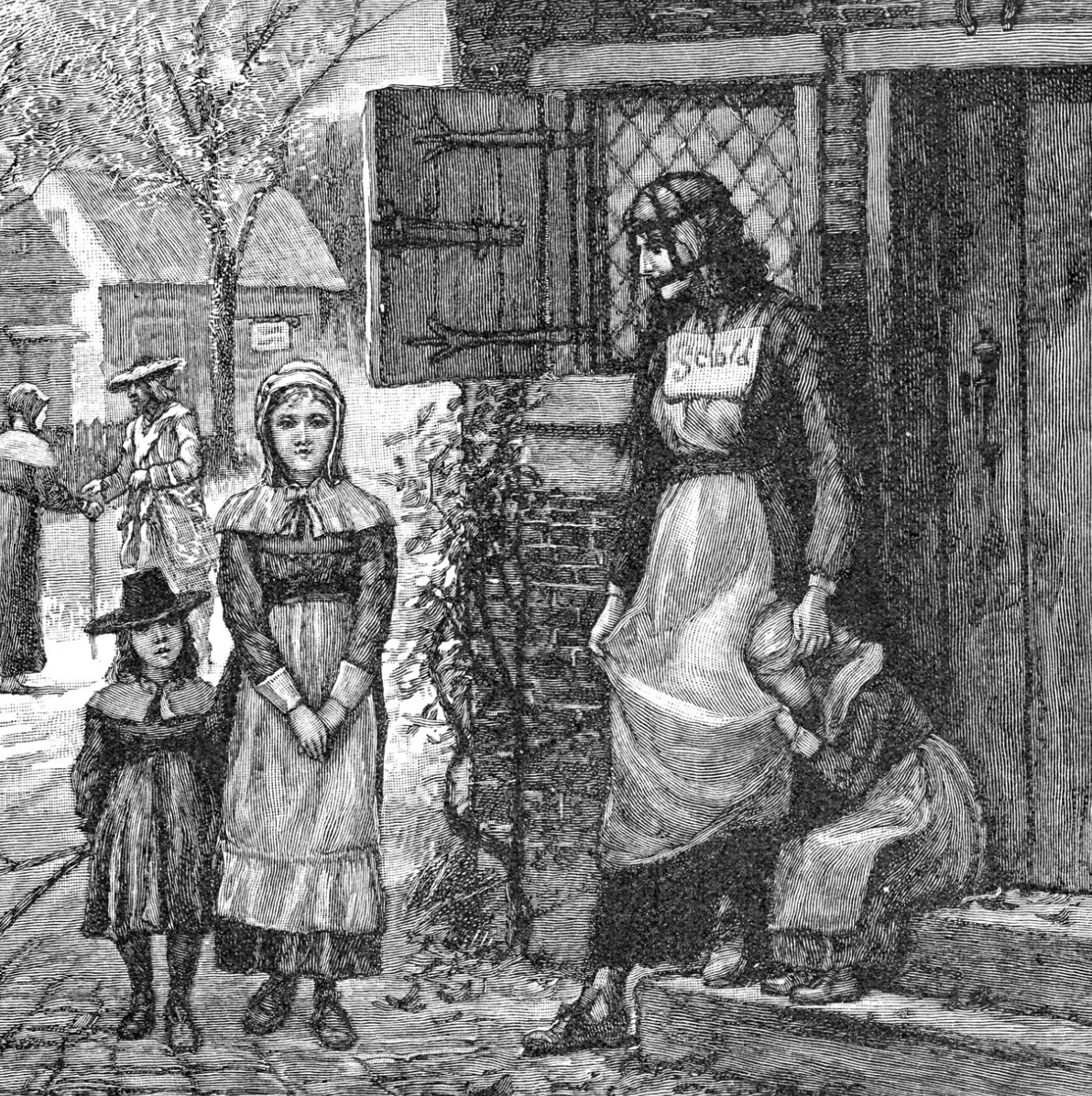
A woman wearing a scold in colonial New England in a lithograph from 1885.
Emma argues that these forms of humiliation were ways to silence people who weren't benefiting from the prevailing regime and would get together to talk. From here, it evolved into a fear of covens of witches, which caused a unique anxiety for the clergy and the emerging middle class.
Throughout this work, Emma bravely writes about being in a controlling, abusive relationship and how being a witch helped her leave and recover. At one point, with another witch, they weave wishes into each other's hair and Emma chokes up as she is still in the early stages of the break-up. By the grave of Laveau, she makes an offering and talks to the dead Voodoo Queen about the pain of the break up and the relationship itself. "This was the perfect liminal space to allow this part of my self, my identity, to (symbolically) die." She later performs a hex on her ex, by lighting twine connected to two human-shaped candles.
To be honest, at first, I was hoping for a bit more juice in Witch Power. I wanted weird recipes for spells and scandalous insights into secret ceremonies and the like. And while spells are cast, ceremonies are performed and skulls rest on altars, they reveal a reality of witch life that is far more intimate and less glamorous than a Charmed episode—and ultimately more politically important.
Take spells for example. In the lead-up to the 2016 US elections, thousands of witches got together to hex Donald Trump online and as part of their process many used orange-coloured items to mimic his fake tan. Did the spells work? Clearly not but for Emma it doesn’t matter. They do the work “socially—not magically.”
And while the book is about witches being women “who live in defiance of society’s expectations and rules”, I didn’t find the ones she encountered particularly radical or marginal. Willow the witch’s suggestion that women at the red tent meeting pour their menstrual blood onto the earth as an offering might seem out there to some but in the main, the witches Emma encounters are involved with practices that I read as more personally transformative than revolutionary or dangerous. (Some could argue this is where the danger lies.) Emma herself describes much of what she experienced as “ritual creativity” and saw that ultimately, the women were finding a safe space to “reclaim their voices, their bodiliness and to produce new ways of thinking”.
While witches may have evolved into evil bitches, kooky empowered babes or black-clad seductresses in the popular imagination, what this book makes clear is that they symbolise the deep, historical and persistent misogyny that women continue to fight against. If a woman strays too far from what society expects, the witch hunt is never far behind.
“Witch Power” by Emma Quilty is with Polity Press.