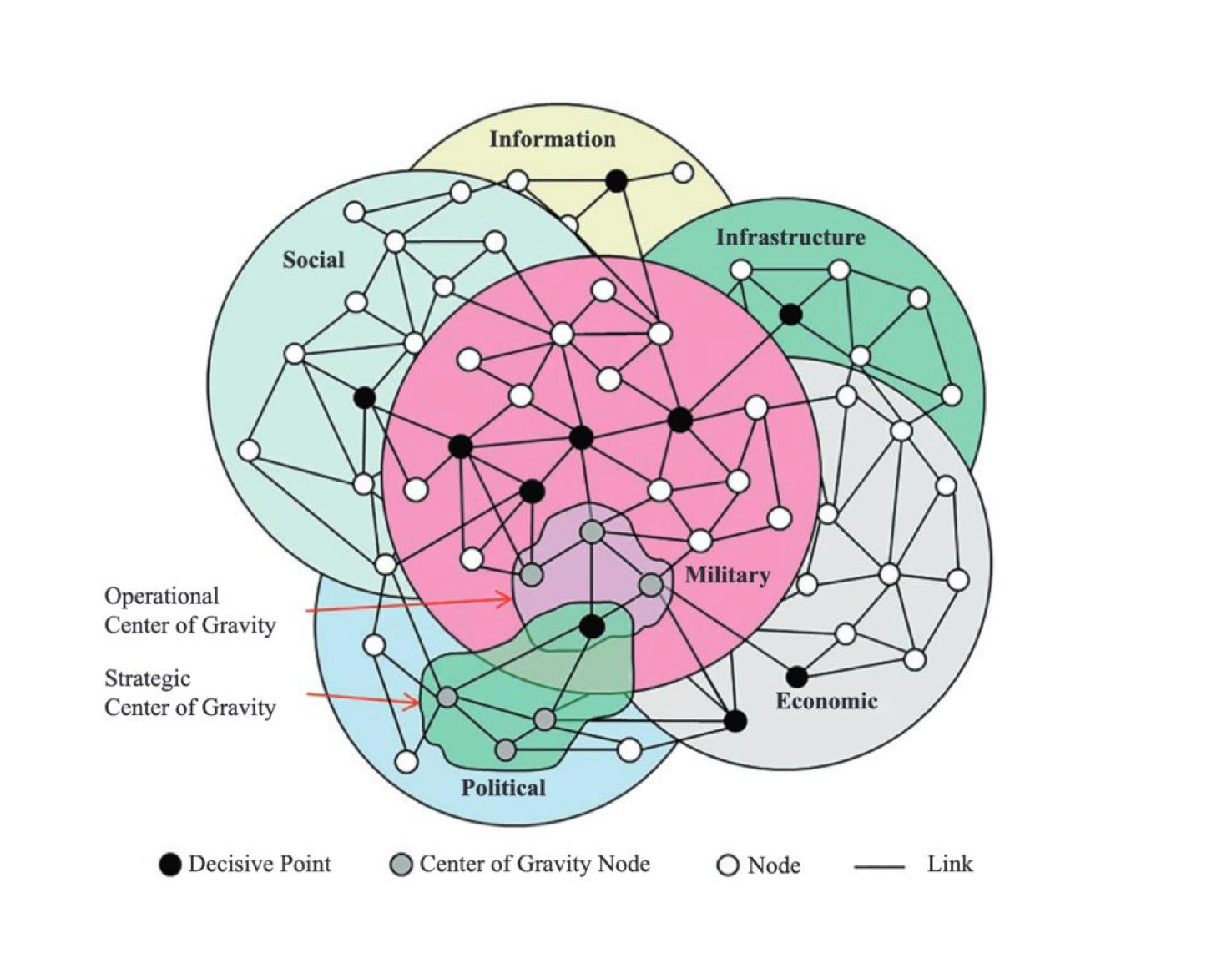
This is the PMESII, a tool developed by the United States Army to analyse war. From a systems point of view, it captures a lot. A photo of soldiers on a frontline is NOT war.
What shocked me the most when I was studying war was how little understood it is; war is a surprisingly elusive concept and defining it is extraordinarily difficult.
The much-studied military theorist Carl Von Clausewitz describes war as “more than a true chameleon” and a “paradoxical trinity”, blending primordial violence, chance-driven creativity, and rational subordination to policy. The American political theorist Quincy Wright, who spent 15 years studying war with contributions from hundreds of scholars concluded in 1942 that an “adequate definition of war is not easy to construct”. Nick Mansfield points out that war’s meaning is “unstable and problematic” and further asserts that war is only ever understood in relation to something else—be it society, sovereignty, authority, politics, love, peace, friendship, or another factor. What he is saying is that war is always embedded in broader social and emotional systems—it is not just a standalone event or tool.
A bit like Mansfield, Giangiuseppe Pili sees that war is not a clearly defined object or event, but used to describe relationships or interactions. He remarks that the debate over the nature of war remains unresolved, and provocatively asks: “One gunshot is not a war, 2 gunshots are not a war… are million gunshots a war?”
Perhaps war is too hard to pin down. Anders Theis Bollmann and Søren Sjøgren challenge the notion that war has an “immutable nature,” asserting instead that its essence is fluid and variable. Tarak Barkawi and Shane Brighton observe “war’s recalcitrance as an object of knowledge” while Dean Hartley argues that just when we think we understand war, “someone does something unexpected, changing the nature of war”. Some scholars reject the idea of settling on an essence of war altogether, proposing a “paradoxical and provisional ontology that is consonant with the confounding mutability of war” as war is essentially an “obdurate mystery”.
Memoirists who have been in war also find it hard to describe. Humanitarian Heidi Postlewait, in Emergency Sex, senses her friend Dr Andrew Thomson understands war in ways she doesn’t and says he talks about it, “like it was a privilege to learn of war” and that he has “some insight into the mystery you don’t”. World War I Soldier Ernst Jünger also recalls this mysterious element of war. After seeing a man, streaming with blood, he remarks: “The war had shown its claws and torn off its pleasant mask. It was so mysterious, so impersonal ... it was like a ghost at noon”. War journalist Anthony Loyd captures the vague and indescribable nature of war when he reflects on his arrest and detention in Sarajevo during the Bosnian War in the early 1990s. When he is mysteriously set free, he asks his captor who is responsible. The captor says:
“Listen …. these are difficult times here. Some of today’s heroes are yesterday’s criminals.” Then came the words I was to hear a thousand times during the conflict, the short-circuit dismissal of any attempt to analyse the confusion, the air of resignation accompanied by hunched soldiers and raised hands. “What can you do?” he said. “It’s war”.
Thus, scholars and memoirists acknowledge that war can be vague, mysterious, and usually understood only in relation to something else. But when efforts are made to settle on a theory of what is war, it is also carved up in too many ways to list. War is a moral problem (Pili 2020). War has a historicity to it (Barkawi and Brighton 2011). Extraction and struggle over the means of war created the “central organisational structures of state” (Tilly 1992). War is a site of revelation and epiphany (Harari 2008). War can only be understood through myth, and how it has been written about in mythology and literature (Hillman 2005). Contemporary war is virtual or hyper-real (Baudrillad 1995). War is connected to the architecture of the international system (Mearsheimer 2001). The West is trying to make war more “humane” through the use of technology (Coker 2001). We live in a post-heroic age, where militaries are reluctant to inflict casualties on their troops or the enemy (Luttwak 1995). It goes on and on.
Take the most recent war in Afghanistan, for example, which has invariably been described as asymmetric, an insurgency, a counter-insurgency, hybrid, a “castle” war, a guerilla war and more. The people I interviewed for my study into the pleasures of war invariably called it a “different kind of war”, “a third kind of war,” and “the right amount of war.” In the collection of Taliban poetry, the poets describe the situation as “jihad” which, in this volume, almost always suggests combat.
Suffice to say, there are many ways to look at war and people can’t seem to describe it. In coming posts, I will look at ways in which people have attempted to pin it down.