Prosecutors challenge Taliban’s gender apartheid
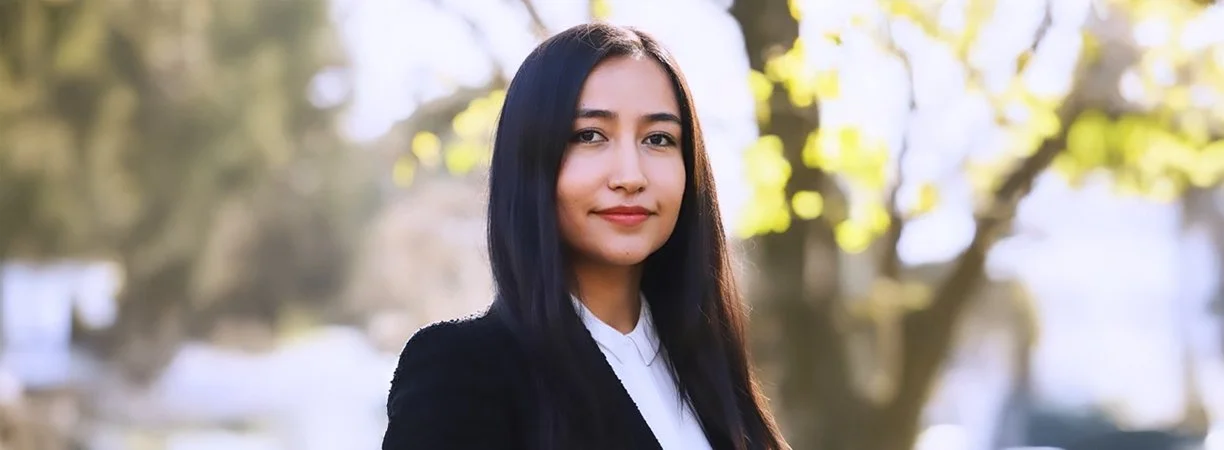
Azadah Raz Mohammad
Since 2021, when the Taliban returned to power, the regime has imposed sweeping restrictions that effectively remove women and girls from public life. They are largely barred from working and face tight controls on their freedom of movement. Girls over the age of 12 are prohibited from attending secondary school or pursuing higher education.
In response, in December 2024, four Afghan human rights organisations submitted a request to the Permanent Peoples’ Tribunal to hear a case about the international crimes and violations against women and girls. In October this year, a hearing was held in Madrid, Spain.
One of the four prosecutors was Azadah Raz Mohammad, an Afghan lawyer, legal advisor to the End Gender Apartheid Campaign, a Fulbright scholar and PhD candidate at Melbourne Law School. She works in international criminal law, gender justice and accountability for crimes in Afghanistan. You can read more about her background here.
On December 11, the Permanent People’s Tribunal for Women of Afghanistan will hand down their judgement in The Hague, Netherlands.
I conducted an email interview with Azadah in the lead-up to the ruling.
Q1. What is the people's tribunal?
A people’s tribunal is an independent, informal forum set up by civil society organisation (“CSO”) or communities to investigate and document human rights violations when formal legal systems are unwilling, unable, or too slow to act. It gathers testimonies, hears evidence, and issues findings or symbolic verdicts, aiming to raise awareness, acknowledge victims’ experiences, and put moral and political pressure on governments or international institutions to pursue accountability.
The same goes for the People’s Tribunal for Women of Afghanistan (“PTWA”), which is an independent, people-led forum that documents and amplifies the experiences of the women of Afghanistan under the Taliban’s oppressive rule. While it is not a formal legal institution and its verdicts are symbolic, the tribunal collects indictments and witness testimonies that serve as important legal and historical records. Its goal is to raise international awareness, validate women’s suffering, and build pressure for accountability where formal mechanisms have often failed.
Q2. You were one of four prosecutors—how did you get involved and what did your role involve?
I first heard about the Afghan-led CSO’s initiative to organise a People’s Tribunal for the Women of Afghanistan a few months before its official announcement during a meeting. I was immediately drawn to the idea and had planned to write to the organisers to congratulate them on this important initiative. Around that time, I received a call from the team inviting me to serve as one of the four prosecutors. The four prosecutors were selected based on our diverse experiences, as well as to reflect Afghanistan’s cultural, linguistic, and regional diversity, ensuring that the procedures were holistic and represented women from all over Afghanistan.
Q3. Security was a huge issue for the women you heard from. How many testimonies did you hear? What were the women saying overall? What is daily life like for women in Afghanistan?
Yes, security concerns were at the forefront of our work with witnesses, particularly those testifying from inside Afghanistan. In total, we worked with 22 witnesses and followed a rigorous procedure to protect their identities. While it was essential to hear their voices and experiences under the Taliban regime, we ensured that all testimonies were given voluntarily and with fully informed consent. Witnesses were made aware of potential risks to guarantee truly informed consent, and even when they indicated there were none, we still took measures to safeguard their identities. We avoided using names, locations, or any identifying details that could endanger them or others. We also made sure that both our in-person and remote witnesses did not share any information that could put another individual at risk. Some witnesses chose to withdraw after learning about the potential risks, and we fully respected those decisions.
The women testified about their daily lives and struggles under Taliban-controlled Afghanistan, including lack of access to healthcare and justice, as well as bans on education, work, freedom of movement, assembly, and speech. They also described facing discrimination and ill-treatment based on their ethnicity and linguistic background. We also heard from women protestors, most of whom testified in person, who recounted their experiences in Taliban prisons and the physical and psychological torture they endured.
At times, it was very hard for me to listen to their testimonies, at times I could see that the whole room was in tears, including us, the prosecutors.
Q4. Can you tell us one story?
One story that has stayed with me is that of a woman who fled from domestic violence with her two children. Instead of receiving help, she and her children were arrested by the Taliban. They lashed and beat her, using racial and gender slurs. Despite her pleas that returning to her husband could cost her life, the Taliban called her husband and handed her over to him.
This woman had been a victim of child marriage herself. She had tried to protect her 11-year-old daughter from the same fate, which led to further domestic violence against her. The Taliban told her that, according to their interpretation, girls as young as nine were eligible for marriage, and therefore her daughter could be married. Ultimately, the mother was unable to protect her daughter, who was forced into marriage at the age of 11.
The mother eventually escaped her abusive husband and fled to Kabul, the capital. However, due to the Taliban’s decrees, no one dared to rent her a room or allow her to ride in buses or taxis, as women without a male chaperone are not permitted to move freely or rent a house. With no safe place to stay and no means to survive, she was ultimately forced to leave Afghanistan. The mother has now been separated from her children for two years.
Q. Did the tribunal hear from a girl or woman about the schooling issue? This issue has particularly touched people.
Yes, the right to education was covered extensively. We heard powerful testimonies from school and university students speaking from inside the country, many of whom described the profound impact of the current restrictions on their daily lives and future aspirations. Their accounts highlighted not only the loss of access to classrooms and learning, but also the emotional toll of being denied a basic human right. These testimonies offered a rare and critical window into the experiences of young people living under an education system that has been systematically dismantled, and they underscored how essential it is for the international community to continue advocating for their right to learn, grow, and participate fully in society.
Q. People would argue that what happens with women in Afghanistan is a cultural issue and that the West/other nations should not meddle in their affairs. What do you think? Personally, when I lived in Afghanistan, I was deeply upset by some of the situations with women. [I did two stints working for the UN in Afghanistan in the early 2000s.] For example, there were many women in my office who were not married as they were worried once they married, they would be forbidden from leaving the house and never work again. I have another friend from Kandahar (now living in Canada) who suffered enormous pressure to return to the city to look after her father and his new wife, and be their cleaner and cook etc. A woman in our Ghazni office was working very hard to help women who had lost their children through divorce, and had stories of women losing two sets of children over the years. Some women suicided from misery. When I tell people these stories, the reaction is sometimes: “That’s just the way it is there.” How do Afghans change the culture? How does a Western person like myself influence the culture? Should I? If I’m honest, I never knew how to help my friends and colleagues.
It is important to distinguish between Afghanistan’s rich and diverse culture and the Taliban’s systematic oppression of women, which many human rights experts and activists now refer to as gender apartheid. Afghanistan, like any country emerging from decades of conflict and authoritarian rule, has endured immense suffering. The women of Afghanistan, in particular, have faced both the direct consequences of war and the persistence of conservative social norms.
While Afghanistan is a traditional society, and gender-based violence existed long before the fall of the republic, these issues are not unique to Afghanistan. In many countries across the region - and indeed around the world - women routinely navigate social pressures that require them to adjust their choices in clothing, marriage, education, and career to satisfy male or family expectations. These cultural challenges, though serious, are not the same as state-engineered persecution.
For this reason, it is extremely dangerous to conflate the Taliban’s policies with Afghan culture. Doing so legitimises their actions and undermines the efforts of Afghans who have long fought for gender equality. The Taliban have implemented a systematic, institutionalised, and legally enforced system of gender apartheid that goes far beyond traditional norms. Their restrictions on women’s mobility, education, employment, and public participation are not merely cultural practices - they are state-imposed measures designed to erase women from public life.
What you witnessed at the community level may reflect longstanding social expectations, but it was not imposed by national law, nor was it enforced through a coercive state apparatus. Under the Taliban, however, these restrictions are codified, policed, and punished. This is the critical difference: culture may influence gender roles, but the Taliban have weaponised state power to turn discrimination into a total system of oppression.
To understand Afghanistan today, we must therefore separate cultural realities from political ideology. Afghan society is not synonymous with the Taliban. Many Afghans have resisted and continue to resist these extreme interpretations. Recognising this distinction is essential not only for accurate analysis but also for supporting Afghan women and communities who reject the Taliban’s vision and seek a future grounded in dignity, equality, and human rights.
Q5. Women in Afghanistan managed to watch the tribunal. How did they do this? I heard there were “watch parties”.
Yes, they have been closely following the tribunal. I have received messages from women in one of Afghanistan’s remote areas, saying that they watched the tribunal and that it has restored a sense of hope, reminding them that they are not forgotten and that their voices are being heard on a global platform. In particular, high school girls from various regions of Afghanistan have sent me messages of encouragement and support for the tribunal. They told me that they are following it closely, that it is their only hope for their voices to be heard, and that the world is witnessing their suffering, often in silence and complicity.
Q6. What are you hoping will come out of it?
I hope that the People’s Tribunal for Women of Afghanistan will amplify the voices of the women and girls of Afghanistan, document the Taliban’s systematic gender-based persecution, and create a pathway toward justice and accountability. I view the tribunal as both a symbolic and practical step to prevent the normalisation of Taliban rule, challenge global silence, and ensure that the suffering of the women of Afghanistan is recognised on an international stage. Above all, I hope it will restore a sense of hope and empowerment to women in Afghanistan, reminding them that they are not forgotten.
Q7. What is the best way for the world to help the situation?
The best way for the world to help women and girls in Afghanistan is by refusing to normalise the Taliban’s rule and taking concrete action to hold them accountable for systematic gender persecution. Governments and international bodies should recognise gender apartheid as a crime under international law and declare the Taliban’s de facto authority as an apartheid regime, support Afghan women-led initiatives, and ensure humanitarian aid directly reaches women without Taliban interference. The international community must also pressure the Taliban to restore women’s rights and work toward an inclusive government in Afghanistan that respects human rights and gender equality. Above all, the world must continue to amplify Afghan women’s voices, keep their struggle visible, and stand in solidarity with their fight for justice and freedom.
Q8. There is also more evidence of abuse by foreign troops, including Australian soldiers. Can you provide details? Are they fresh allegations?
Definitely, during their 20 years of combat in Afghanistan, there is evidence and numerous allegations of serious violations of international law, including war crimes by foreign troops. For instance, there were two notable incidents in Kunduz.
In 2009, a Kunduz airstrike by foreign troops resulted in the deaths of over 100 civilians, and the commander who authorised the call for air support was later scrutinised for potential negligence. Again, on October 3, 2015, a Médecins Sans Frontières (“MSF”) trauma hospital in Kunduz was repeatedly bombed by foreign troops, killing 42 people, including 14 MSF staff, 24 patients, and 4 caretakers. The international troops involved later described it as a tragic mistake caused by targeting and communication errors, though MSF and others condemned it as a violation of international humanitarian law. Both of these incidents were either not properly investigated, or the investigations were later dropped. There are many more such incidents; I have recounted only two that come to mind.
So far, Australia is the only country with troops on the ground in Afghanistan that is investigating alleged crimes, and as an Afghan Australian, I am following these developments closely and am encouraged by them.
Q10. The Kunduz story is well known. Would it be possible to have details about the other allegations at some point? Also, it is interesting that Australia is the only other country investigating, especially considering how many foreign forces there were.
One of the deadliest but least-investigated incidents involving foreign troops in Afghanistan was the 2009 Granai airstrike in Farah province, where Afghan officials reported that more than 90 -140 civilians, many of them women and children, were killed after foreign military aircraft repeatedly bombed a village during fighting with the Taliban. Despite the scale of the tragedy, the incident was never subjected to a full, transparent investigation: the foreign military conducted only an internal review, released no evidence, and dismissed Afghan casualty estimates without joint verification; survivors were not interviewed, the Afghan government’s findings were sidelined, and no personnel were held accountable. As a result, Granai became a symbol of the broader lack of accountability surrounding civilian casualties during the conflict.
Read more here: https://www.theguardian.com/world/2009/jun/03/afghanistan-us-airstrikes-errors
Q11. Once the decision by the PTWA is handed down, what will be the next practical steps?
Once the PTWA delivers its decision, the next steps would involve using its findings to advocate for international accountability, press governments and global institutions to take concrete action against gender-based oppression, and amplify the women of Afghanistan’s voices on the world stage. Although the tribunal’s ruling is symbolic and non-binding, it can serve as documented evidence of systematic violations, support legal and diplomatic efforts, and strengthen global solidarity with the women of Afghanistan while keeping pressure on the Taliban to respect women’s rights and pursue an inclusive, rights-respecting governance in Afghanistan.
Q12. Can you tell me a little about your background? When did you leave Kabul?
It is rather long, and I had to leave Afghanistan twice like most of my people. I have some of journey in this interview: https://www.atlaswomen.org/profiles/2025/1/29/azadah-raz-mohammed
However, I left Kabul for the last time (for now) in May 2018 when I got married and worked with the ICC as a visiting professional and then later moved to Australia to start my PhD at Melbourne Law School.
The People’s Tribunal decision will be handed down in the Hague on December 11. You can read more about it here.